Showing posts with label fish village. Show all posts

Monday, June 14, 2010

White Cloud Mountain Minnow - one tough fish!


My intention was to construct a second moss wall to span the whole of the planted tank. As I was reviewing the situation I noticed there were only two fish in the 10g:view, Huh?

Two Neon Tetras and . . . no White Cloud Mountain minnows? What happened to five fish, overnight? Vanished, *poof* - gone. I also noticed an unusual amount of protein on the water column surface. Hmmmm . . .
Should have checked the filter as soon as I noticed missing fish.  
Ohhhhhhh, there they are, trapped under the filter basket.

I swapped the Aqua Clear 30 from the Shrimparium to the planted with the intention of making the 10g planted into the shrimparium due to the moss walls. Somehow all five WCMm's got sucked into the filter through the hole in the intake drilled for the DIY CO2. Nice.


All five are missing dorsal fins, most are missing all or part of their soft dorsal, one is missing pectorals. One has half a tail, very streamlined.

I dropped all five into the aquarium fully prepared for the possibility the Neon Tetras would make lunch and dinner out of the injured fish.  It appears the Tetras missed their shoaling pals; they seem not to have noticed the fish are injured. All five White Cloud Mountain minnows are swimming around as if nothing unusual has happened.


So on with the plans . . .

Thursday, January 28, 2010

Fish Village Update

The recent algae outbreak forced a decision to move the whole fish rack again.  The rack is now no longer in front of the windows.  The flooding of direct sunlight and the shop light T8 tubes, even with a reduced photo period to seven hours per day, was just too much light.  The photo period has been raised again to nine hours per day.  There is still some residual algae on the lower part of the aquarium glass near the substrate.  This can be easily managed by the addition of some Olive and Tiger nerite snails.

The move caused a significant White Cloud Mountain minnow fry die-off.  This was totally our fault.  There was not enough water left in the tanks as we moved them.  Sad about the loss of fry and will be more careful in the future.  So the remaining population are all at least 1/4" to 3/4" long and there are four in the 10g:redux Shrimparium, four in the 10g:view planted tank, plus the three original parents in the 10g:view.  Not bad for our first fry, especially since they were totally unplanned for.  We also lost one of the three neon tetras.  Not sure why, it died two days after the move.

The nice surprise just after the new year was two berried American glass shrimp as we posted earlier.  They have been moved to a five gallon aquarium with one male.  They survived the move, seem not to have dropped any eggs, having been in the five gallon aquarium for a week now.  They are due to hatch shrimplets anywhere in the next week or two as best as we can figure.  This is very exciting as these are the babies we actually wanted.

A new camera is wending its way to us but it may be as much as two weeks before it arrives therefore; no pictures at this time.


Monday, December 28, 2009

Newly Purchased Tanks ~

So, some caved in and bought the tank or received one for Christmas; welcome to the aquarium hobby!

For those of you who have not set up your tank yet, we thought we would insert some embarrassing shots of mistakes at this point in the series, in hopes of steering you clear of some pitfalls. For those of you who did not go to Grandma's and have already started filling your tank, we hope this article answers some questions as well. Fishless Cycling was covered on December 20, 2009 in an article entitled "New Tank Acclimation, Phase I"
Fishless Cycling comes after these set-up tips.

If you have dry driftwood, start soaking it in a bucket of water. It will take about two weeks for it to become saturated. Yes really, sorry. However, you are doing a fish-less cycle, right? Not a big deal, by the time your cycle is complete, your driftwood will be saturated.

The first thing you should do with a new tank is check for leaks by filling it. Pretty simple, right? New tanks have been known to leak on rare occasion; the 10g:view leaked after three weeks. We never did find out what caused the leak, the silicone sealing was fine, there were no cracks in the glass, it is a mystery.
A 24 hour test should be sufficient, yes really.


Next we clean the inside glass with plain old vinegar and newspaper or paper towel. Do not use glass cleaner. {period}
If there is no vinegar in the house, use the plain, pure ammonia you bought for your fish-less cycle. {It was on the list in the article on Holiday Aquarium Purchasing}

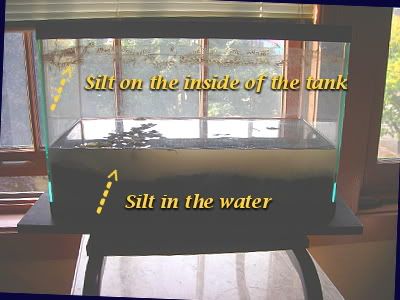
You will be surprised at how quickly the glass gets dirty and smudged. Now we are ready for the substrate; whatever you use for substrate, wash it thoroughly. The substrate has been tossed around, rubbed against itself and a fine dust will cover everything. Do not expect your filter to clean that stuff up, see stupidity here --->

This is what happens when we do not read the distructions, we end up with an embarrassing, frustrating mess. The substrate can be washed in a strainer or colander, if the holes are small enough to prevent the substrate particles from falling through. A hair strainer for your drain will help keep that stuff out of the drain, or a piece of cheese cloth will work as well.

Despite best efforts, the water will be cloudy but not as bad as this. There may be some silt dust on the glass but it is not serious, as we have already cleaned the inside glass of anything greasy or oily that would trap silt particles, leading to potential scratching. The best way to keep the remaining silt to a minimum is to partially fill the aquarium by 1/3, then siphon out that water. Then start your refilling with conditioned water. Water conditioner is super important in your fresh, out-of-the-tap water. It removes chlorides and chlorine. Do not skip the purchase of this stuff. Chlorides in your water will kill your beneficial bacteria crop and your fish. If you are using a bucket or gallon jug, place a soup bowl or dinner plate into the aquarium and gently pour the water onto that surface. The bowl or plate will diffuse the water current and keep everything from rising into the water column.

A second option, which we use, is the "gentle-fill" method.
In our fish-village, we have a nice metro-style, fish rack.
Our shop light {not seen here} is suspended from a shelf above the two ten gallon tanks. We lucked out and acquired two five gallon carboys for $5. One is used for gentle fill, the other is used for waste water drain. We take silly pride in our carboys. The same can be achieved with a bucket or tub. A piece of air hose cut to length, one end weighted in the bottom of the carboy or bucket, the other end dropped into the tank. The benefits of this method are; little if any disturbance of the substrate, condition all the water needed for a refill or water change all at once and less work while doing tank maintenance. We can actually sit down and write while the gentle fill is taking place. Great solution if you do not have access to a full-fledged fish room, or your water source is too far away to be practical. Cheap and efficient, we love that!

That is more like it. The cloudiness is minor, our filter can certainly handle it within an hour or two. We filled the tank for demonstration purposes, you should fill your tank one half to two thirds full if you have long arms. Planting and arranging is best done in a tank with less water, not more.

Should you be adding hard-scape such as driftwood, rocks or shelving to create layers, it should be done before your final half to two thirds fill. It is much easier to work with a half filled tank than to frustrate yourself sloshing water all over the place. Driftwood should have been soaked for two weeks or so prior to starting this part of your aquarium project. Dry driftwood floats, hence the name. If you did not soak your driftwood, you can weigh it down with something. Plants go in next, pay attention to two things; your eye travels naturally from bottom left to top right. Place your plants according to the natural way the eye travels. Second, you eye will target the upper, right corner of dead center, that is where you want your focal point to be. Specimen plants or optical focus should be in that area. Attach your hardware before getting to the fussy part of small plant placement. When you are satisfied, top off the tank and start your hardware up.

Sit where you would normally to watch the tank. Watch it during daylight and with all the lights off except the tank light. This will give you a good idea of what your final project will look like. Something not quite right? Now is the time to fix it by moving things around, before your livestock moves to into the tank.

Now you wait. You can re-read New Tank Acclimation, Phase I, research livestock or join an online community of experienced aquarists. We suggest all three. Our experience is that aquarists are vey friendly and helpful. No question is too lame, they are happy to help.

We reviewed the AqAdvisor, Aquarium Advisor on our old site a month or so ago. It is a great stocking tool, designed to help you make choices about which fish and shrimp will work well in your tank. It will give you warnings if you are planning to stock fish that are not compatible or too many fish for your tank size and filtration. Give it a try, questions and feedback are welcomed by the developer. They help him as much as they help you.

That is about it for this article. Next article we will be covering tank logging. As always, your comments and feedback on our experiences are welcome.

In this series:


Friday, December 25, 2009

Merry Christmas from Fish Village


My Christmas present to myself was restoring a view through the 10g:view. We have had algae, lots and lots of algae. Miserable amounts of three types
at last count. The worst by far was the hair-algae. I tried an Oto a month ago but the poor little guy did not survive transportation shock despite my
best transportation and acclimation scheme.
{read more . . . }